
SERVICE 03
Deforestation Risk Monitoring | EUDR Compliance
Understanding the risk of deforestation within your portfolio or supply chain has never been more important - or more difficult. Complex global value chains, unreliable self-reported data, and tightening regulations mean that companies and financial institutions can no longer rely on policies and sustainability reports alone.
Frontierra provides satellite-based deforestation risk assessment and monitoring for financial institutions, corporates, and supply chain operators worldwide. Our platform delivers asset-level analysis with global coverage, going far beyond sector and policy based insights alone.
You get clear, actionable recommendations, not just data, so you know exactly which assets require attention and what steps to take next.
Ready to understand your deforestation exposure? Get in touch with our team or request a demo.
DEFORESTATION RISK
What Is Deforestation Risk and Why Does It Matter?
Deforestation risk refers to the exposure that businesses, investors and lenders face when their operations, investments, lending portfolios, or supply chains are linked to land where forests have been cleared or degraded. That exposure can be financial, regulatory, or reputational, and increasingly, all three at once.
Deforestation is directly linked to both climate change and nature loss, making it a material business risk in its own right. Forests regulate rainfall, stabilise soils, store carbon, and support biodiversity. When they are lost, the consequences are wide-ranging, from increased flood risk and landslides to drought, wildfire, and accelerating biodiversity loss. These physical consequences are increasingly being factored into environmental due diligence requirements by regulators worldwide.
For financial institutions with lending or investment exposure to agriculture, forestry or land-use sectors, deforestation risk monitoring is now a core part of responsible portfolio management, and for many, a mandatory one.

EUDR
EUDR Compliance: What You Need to Know
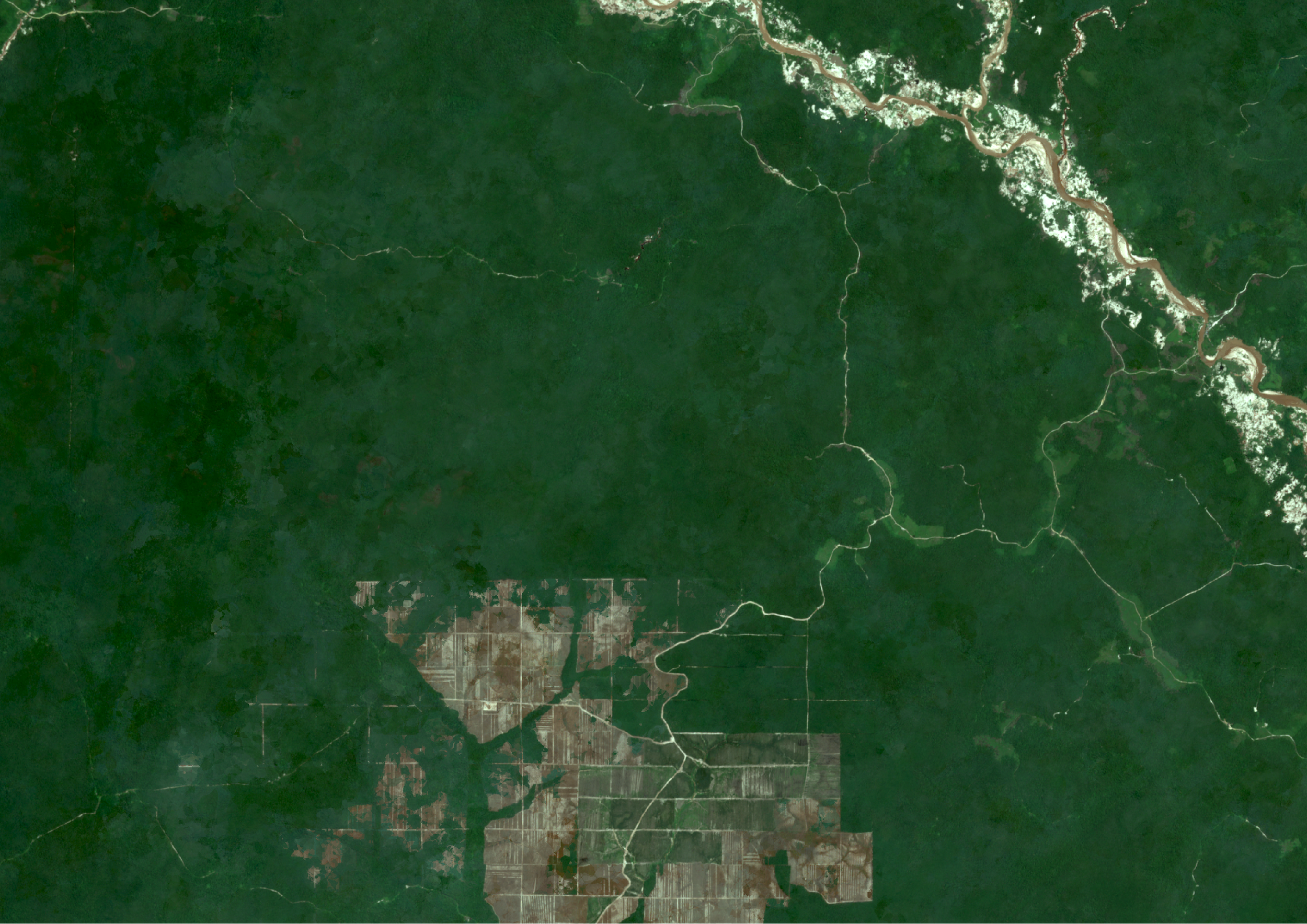
The EU Deforestation Regulation (EUDR) requires companies placing certain commodities and derived products on the EU market to demonstrate that they have not contributed to deforestation or forest degradation after 31st December 2020. Non-compliance carries significant penalties, including fines of up to 4% of annual EU turnover and seizure of goods.
Frontierra's EUDR compliance service uses satellite analysis to assess every plot of land in your sourcing locations database. We establish forest cover at the baseline date, identify presence or absence of deforestation or degradation that has occurred since, evaluate legality and produce the evidence needed to support due diligence statements under the regulation.
Our solution is built to integrate with your existing systems and workflows, and scales efficiently as volume increases, making it practical for large operators managing complex, multi-country supply chains.
How Frontierra Differs
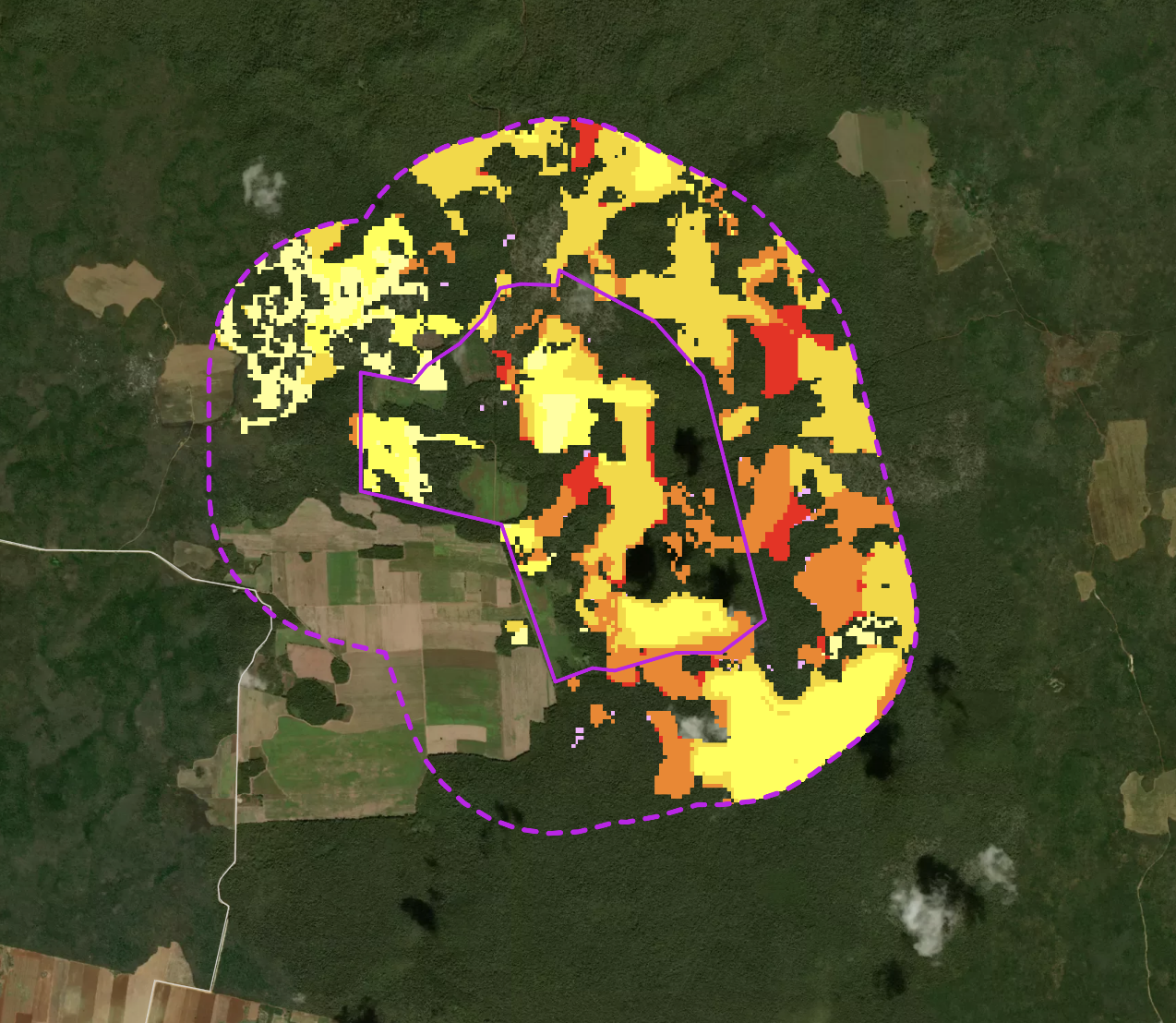
Frontierra’s approach differs from others, in that we combine a fully automated initial assessment, with verification by experts who have extensive experience in validating forest cover and land use maps. Whilst more time consuming, this step is integrated as Frontierra is particularly concerned with facilitating a just transition and the potential negative impacts of fully automated EUDR assessments and the potential negative impact on smallholder producers being cut out of a supply chain based on erroneous forest loss or deforestation data.
OUTLOOK
Incoming Legislation in the UK, USA and beyond
The EUDR is the most advanced deforestation regulation currently in force, but the regulatory direction of travel is clear. In the UK, the Forest Risk Commodities regime under the Environment Act 2021 is awaiting implementing legislation, and in the US, both the proposed federal FOREST Act and New York's TREES Act signal growing demand-side pressure on deforestation-linked supply chains.
Companies that build robust deforestation due diligence now, mapped to EUDR and FAO definitions, will be well positioned to demonstrate compliance as further legislation emerges. Our assessments are designed with this in mind: providing the spatial evidence, traceability, and documentation that meets current regulatory requirements and can be readily adapted as new frameworks take effect.
FOREST-RISK COMMODITIES
High-Risk Commodities: Deforestation Monitoring Across Your Supply Chain

Frontierra’s deforestation risk assessment is integrated in the Climate & Nature Intelligence platform, and can assess exposure across all major commodities linked to forest loss.
Palm oil
A leading driver of tropical forest loss, particularly in Southeast Asia
Beef and cattle
Livestock farming is a primary cause of land clearance in Latin America
Timber and wood products
Directly linked to forest loss through logging and land clearance
Soy
Responsible for large-scale clearance across South America, especially in the Amazon and Cerrado biomes
Coffee
Production in biodiversity-rich regions carries significant forest conversion risk
Cocoa
Strongly associated with deforestation in West African producer regions
Rubber
Plantation expansion drives deforestation in Southeast Asia and parts of Africa
RISK ASSESSMENT
Deforestation Risk Assessment for Financial Institutions
Frontierra’s deforestation service is built around the needs of financial institutions with lending,investment and / or supply chain exposure to agriculture and land-use. As deforestation-free finance frameworks evolve and mandatory reporting requirements become more stringent, satellite-verified evidence of deforestation exposure is increasingly essential. Our value chain mapping service extends this analysis across complex global supply chains, tracing environmental risks from source to asset.
We work with banks, asset managers, and development finance institutions to:
Assess deforestation exposure within existing lending and investment portfolios
Screen potential investments and acquisitions for deforestation risk prior to commitment
Align with deforestation-free finance commitments and voluntary frameworks
Prepare verified evidence for regulatory disclosure and mandatory reporting
Our clients benefit from the same depth of analysis used on TNFD pilot projects with leading global financial institutions — applied to deforestation risk.
Ready to Assess Your Deforestation Exposure?
Whether you need a one-off deforestation risk assessment or ongoing monitoring across a global portfolio, Frontierra can help. Request a demo or get in touch to speak with our team. For the latest thinking on deforestation regulation and supply chain transparency, visit our Insights page.
Frequently Asked Questions
-
Deforestation destabilises soils, reduces natural flood barriers, and can accelerate land degradation and desertification. These physical consequences increase exposure to a range of hazards - including landslides, wildfires, and drought - that can affect assets, infrastructure, and communities in surrounding areas.
-
A deforestation risk assessment is a point-in-time analysis of a specific location or portfolio - establishing current forest cover, recent loss, and regulatory exposure. Deforestation risk monitoring is ongoing: it tracks changes over time and alerts you when new deforestation is detected near your assets or within your supply chain. Frontierra’s Climate & Nature Intelligence Platform offers both.
-
These two terms are often used interchangeably, but they are not the same; the distinction matters significantly for assessing nature-related risk.
Forest loss is a broad, observable metric referring to any reduction in tree cover, regardless of cause. This includes timber harvesting, fire, storm damage, and agricultural conversion — it is what satellite monitoring systems detect.
Deforestation is a subset of forest loss. It refers specifically to the permanent conversion of forest to another land use, such as agriculture or infrastructure. By definition, it implies both intentionality and permanence.
The definition of deforestation varies across the frameworks most commonly used in practice. The FAO defines forests by canopy cover and tree height thresholds, and explicitly excludes areas under regeneration or predominantly under agricultural use — meaning temporary loss within a managed context does not automatically constitute deforestation. The EUDR builds on the FAO definition, defining deforestation as the conversion of forest to agricultural use after 31 December 2020, regardless of legality.
Our assessments are conducted in line with these definitions, distinguishing forest loss from permanent conversion and applying the regulatory thresholds and cutoff dates required for EUDR alignment. Where clients operate under different national regulatory frameworks or have internal deforestation policies that apply alternative definitions, we tailor our methodology accordingly — ensuring that findings are always decision-relevant within the context that matters most to the client.
-
Deforestation refers specifically to the permanent conversion of forest to another land use. While an important metric, it captures only part of the picture, biodiversity and carbon are not stored in forests alone.
Natural ecosystems encompass a much broader range of habitats: savannas, wetlands, peatlands, grasslands, and mangroves, among others. These can be degraded or permanently converted without any tree cover loss being detected, meaning deforestation metrics will not register the impact.
The Accountability Framework Initiative (AFi) addresses this gap by defining conversion as the replacement of any natural ecosystem with agricultural or other human land uses, regardless of whether the habitat meets the definition of forest. Many corporate and financial institution policies now include both no deforestation and no conversion commitments — recognising that a forest-only focus is insufficient. Our assessments are designed to evidence compliance with both, providing the spatial and temporal analysis needed to demonstrate that neither deforestation nor broader ecosystem conversion is occurring within a company's operations, supply chain, or a financial institution's investment and lending portfolio.